NEWS AND EVENTS
Rethinking innovation in military medicine
News
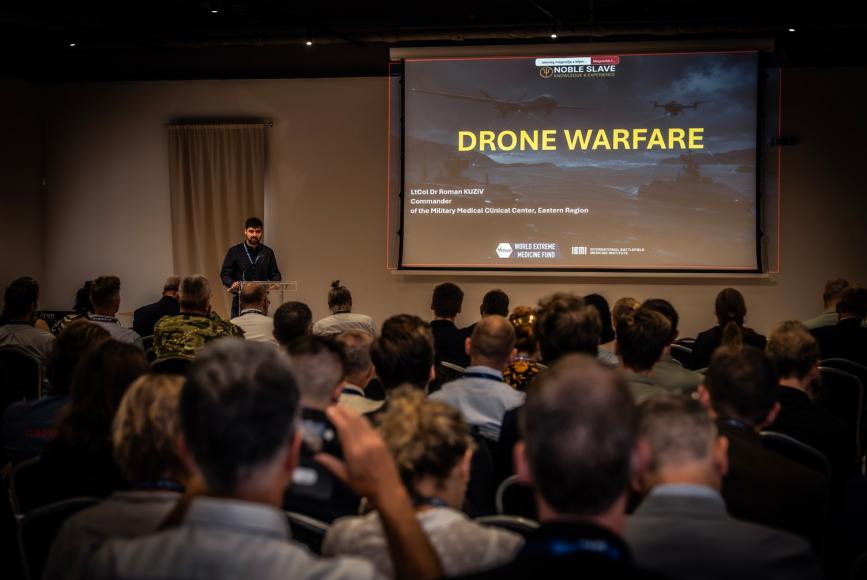
The operational environment is changing quickly, and military medicine has to change with it. New technologies are appearing on the battlefield, evacuation may take longer than expected, and medical personnel have to provide care in increasingly difficult conditions. These challenges were among the main topics of the NATO MILMED COE's Medical Innovation Workshop, held in Budapest from 1 to 3 September 2026.
Opening the workshop, Brigadier General Dr. Jens Diehm, Director of the NATO Centre of Excellence for Military Medicine spoke about the pressure to adapt to a rapidly changing operational environment. “We are under pressure. We don’t know when a potential enemy is going to attack. So we can’t afford to waste time,” he said.
For Dr. Diehm, innovation begins with the right mindset. New equipment and technologies will continue to appear, but their value depends on how people respond to them, learn to use them and adapt them to operational needs. He pointed to Ukraine as an example of how a culture of initiative can encourage people across military and civilian society to contribute ideas and find solutions to problems as they emerge. This requires an environment in which people are encouraged to think differently, learn from experience and make the best possible use of the resources available to them. Innovation therefore becomes a continuous process rather than something that starts and ends with the introduction of a new technology.
This thinking also shaped the concept of the workshop. Under the leadership of U.S. Navy Captain Dr. Corey Gerald Gustafson, Chief of the Lessons Learned and Innovation Branch, the LLIB took the lead in organising and delivering the first Medical Innovation Workshop, with valuable support from the MILMED COE’s Support Branch. The workshop brought together national medical planners and innovators, military medical professionals, researchers, academia and industry, creating an opportunity to exchange experience, share ideas and better understand each other’s requirements.
The Centre provided the platform and acted as a driver for this process, while the knowledge, experience and ideas came from the wider military medical community. Industry, academia, researchers, planners and practitioners all have a role in turning ideas into solutions that can eventually be used in the field. As Dr Diehm described his own role, “I want to support the whole of you, the whole of us, to do it better.”
General Zsolt Sándor, Chief of the Defence Staff of the Hungarian Defence Forces, approached the subject from a practical perspective. “Innovation has always been driven by necessity,” he said. Military medical personnel may have to work with limited supplies, disrupted communications or delayed evacuation while treating casualties in difficult and dangerous environments. He also suggested a simple way of judging whether an innovation has real value. “Does it solve a real operational problem? Does it improve effectiveness or efficiency? Can it be implemented in the real operational conditions? And ultimately, does it improve outcomes and help us to save lives?”
The realities behind these questions were demonstrated in the opening keynote address by Lieutenant Colonel Roman Kuziv, Commander of the Eastern Medical Forces of the Armed Forces of Ukraine. Drawing directly on Ukrainian experience, he described an operational environment that has changed fundamentally with the widespread use of drones. Methods developed for earlier battlefields can no longer always be applied in the same way. Drone warfare affects every operational domain, with military medicine among the areas facing some of the greatest consequences. According to the experience presented by Kuziv, drones currently account for around 75 percent of injuries, with the head and neck particularly affected. The battlefield has also become increasingly transparent, with movement more easily detected and targeted. This has consequences throughout the medical chain, from protection and point – of - injury care to casualty evacuation. Medical teams therefore have to reconsider where, when and how treatment can be provided and how casualties can be moved when traditional evacuation methods may expose both patients and medical personnel to further risk.
The workshop brought these operational challenges together with a wide range of possible responses. Industry representatives presented developments covering prehospital and emergency care, haemorrhage control, portable oxygen generation, blood and plasma technologies, diagnostics, medical simulation and training, digital health, CBRN protection, deployable medical infrastructure and other areas of medical support. The variety of solutions reflected the equally wide range of problems that military medical personnel may encounter in future operations.
Academic, research and training organisations also formed an important part of the community. Participants included Harvard Medical School, the University of California San Francisco, the Uniformed Services University of the Health Sciences and its National Institute for Defense Health Cooperation, Johns Hopkins University, George Washington University School of Medicine and Health Sciences, the University of Maryland Center for Blood Oxygen Transport, the USC Center for Body Computing, the Military Institute of Medicine - National Research Institute, the Military Medical Training Center, the Polish Military Medical Training Centre / Military Medical Academy in Łódź, the US Army Medical Center of Excellence, CETC (Ministry of Defence & UMC Utrecht), Aboa Space Research Oy, the Coalition for Epidemic Preparedness Innovations, the Henry M. Jackson Foundation in Support of USU NIDHC, FAQIR Institute, MKC Training and Skills Meducation. Their participation brought education, research and training into the same discussion as operational experience and technological development.
Discussions throughout the workshop repeatedly returned to the realities of the current operational environment. Medical teams may have to care for casualties for longer periods before evacuation becomes possible. Power, supplies and communications cannot always be guaranteed. Technologies such as drones are changing the threats faced by medical personnel, while at the same time new technologies are creating different possibilities for treatment, training and medical support.
Bringing these different communities together is therefore an important part of the innovation process. A technological solution may begin in industry or research, while its practical requirements come from those working in military medicine. Operational experience can reveal problems that were not previously anticipated, and training can show whether a new approach can actually be used under pressure. The exchange between these groups allows ideas to be questioned, adapted and tested before they become part of operational practice.
For military medicine, keeping pace with change will depend heavily on how quickly new ideas can be understood, tested and used in realistic conditions. The purpose of military medicine remains the same. Casualties still need effective care, often in circumstances that are difficult for most of us to imagine. The challenge is to make sure that the people providing that care have the knowledge, equipment, training, experience, adaptability, resilience and flexibility to respond when those circumstances change.
Closing the Medical Innovation Workshop, Dr. Diehm announced that the next workshop is planned for September 2027.
UPCOMING COURSES
JOIN US ON FACEBOOK!
The live Facebook feed loads after you accept cookies.
JOIN US ON YOUTUBE!

JOIN US ON LINKEDIN!
MILMED COE FOLLOW