NEWS AND EVENTS
The role of virtual reality in the simulation activities of NATO Exercise Vigorous Warrior 2026
News
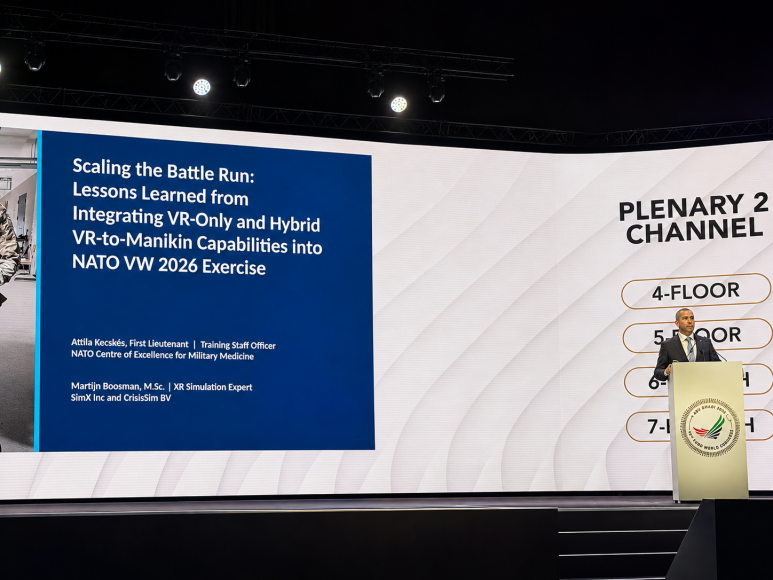
First Lieutenant Attila Kecskés, Medical Staff Officer and VR Subject Matter Expert (SME) in the Training Branch of the NATO Centre of Excellence for Military Medicine (MILMED COE), delivered a presentation on the Centre’s experience with VR-based medical training during NATO Exercise, Vigorous Warrior 2026 (VW’26) at the 46th ICMM World Congress of Military Medicine.
The presentation, “Scaling the Battle Run: Lessons Learned from Integrating VR-Only and Hybrid VR-to-Manikin Capabilities into NATO VW 2026 Exercise,” examines the VR-based and hybrid training approaches used during Vigorous Warrior 2026 in Estonia, together with the operational lessons learned.
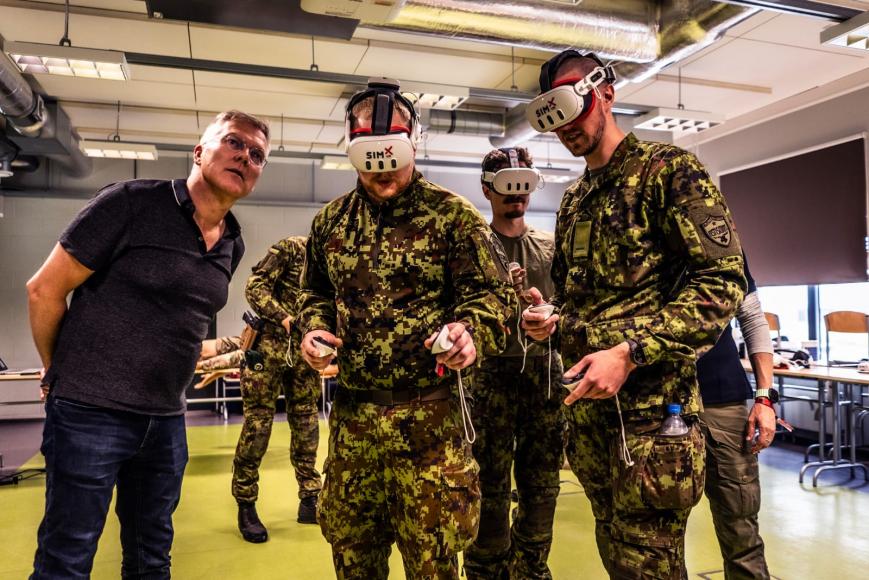
Two VR stations and a manikin-based training station
During Vigorous Warrior 2026, participants trained at a hybrid Casualty Collection Point (CCP). The training site comprised two multiplayer VR stations and one high-fidelity manikin station. The Romanian SMURD team and SimX supported the VR elements, while Laerdal provided equipment for the manikin station.
The stations were designed to complement one another within a single training pathway. VR scenarios focused on situational assessment, treatment prioritisation and team decision-making. The manikin station supported practical procedures, equipment handling and other hands-on elements of patient care.
At the start of the exercise, approximately 90 medical personnel completed the VR system’s tutorial in rotating groups of four to six. Twelve headsets were available across two rooms. The capability supported the exercise for five days, including the Day 0 orientation and a continuous 36-hour training period.
The flexibility of VR was particularly evident when circumstances changed shortly before the exercise concluded. The planned conventional TACEVAC activity could not proceed, so the organisers quickly adapted that part of the exercise by preparing VR-based tasks. By the following morning, approximately 20 simulation injects were ready. This experience demonstrated how VR can help incorporate new tasks at short notice into a complex exercise.
What did the evaluation show?
The presentation considers operational observations separately from participant feedback. The questionnaire analysis included responses from 53 participants. Their feedback indicated high engagement and immersion, as well as perceived learning value. On a seven-point scale, participants gave an average score of 5.18 to the statement that VR had helped them identify gaps in their own performance.
Making these gaps visible can give feedback and further practice a clearer focus. However, this finding is based on self-reported responses. The exercise evaluation did not objectively measure skills development or subsequent patient outcomes, nor did it establish cost-effectiveness in a specific setting.
The learning objective should guide the choice of method
One of the presentation’s main conclusions is that VR is best used as part of a broader training portfolio. Different methods support different learning objectives. VR can provide repeatable practice for decision-making, high-risk cases, or scenarios that require demanding environments or substantial consumables. Manikin- and actor-based training focuses on practical procedures and equipment use. Live exercises allow teams to practise logistics, coordination, communication, teamwork and established procedures in a realistic setting.
Further research should include controlled comparisons, objective performance measures, and prospective assessment of total lifecycle costs and equipment utilisation. The Vigorous Warrior experience provides practical lessons for implementation and helps identify priorities for future evaluation.
At VW’26, VR made a substantial contribution to the successful delivery of the exercise. It enabled rapid adaptation as requirements changed, strengthened the resilience of exercise planning, and offered a potentially cost-effective way to sustain complex simulation activities. The successful implementation also increased confidence in VR as a credible simulation capability and laid a strong foundation for its wider acceptance in the military medical community.
Author: 1stLt Attila KECSKÉS
ORCID: https://orcid.org/0000-0002-6169-5358
UPCOMING COURSES
JOIN US ON FACEBOOK!
The live Facebook feed loads after you accept cookies.
JOIN US ON YOUTUBE!

JOIN US ON LINKEDIN!
MILMED COE FOLLOW